History of the Mayflower Compact
Before coming to the New World, the Pilgrims had lived in Leyden, Holland from 1608 to 1620. While there, they absorbed the liberating influences of Dutch society and shifted toward a more democratic form of self-governance.
As the passengers aboard the Mayflower journeyed across the Atlantic, tensions arose among the three factions: the Separatists seeking religious freedom, the merchant-adventurers seeking their fortune, and the crew seeking their livelihood. It became apparent that if these passengers were to survive in an alien land, they needed to consent voluntarily to a cooperative form of government. Before a single person went ashore, it was necessary to draw up an instrument of self-government for the little band to replace the original patent.
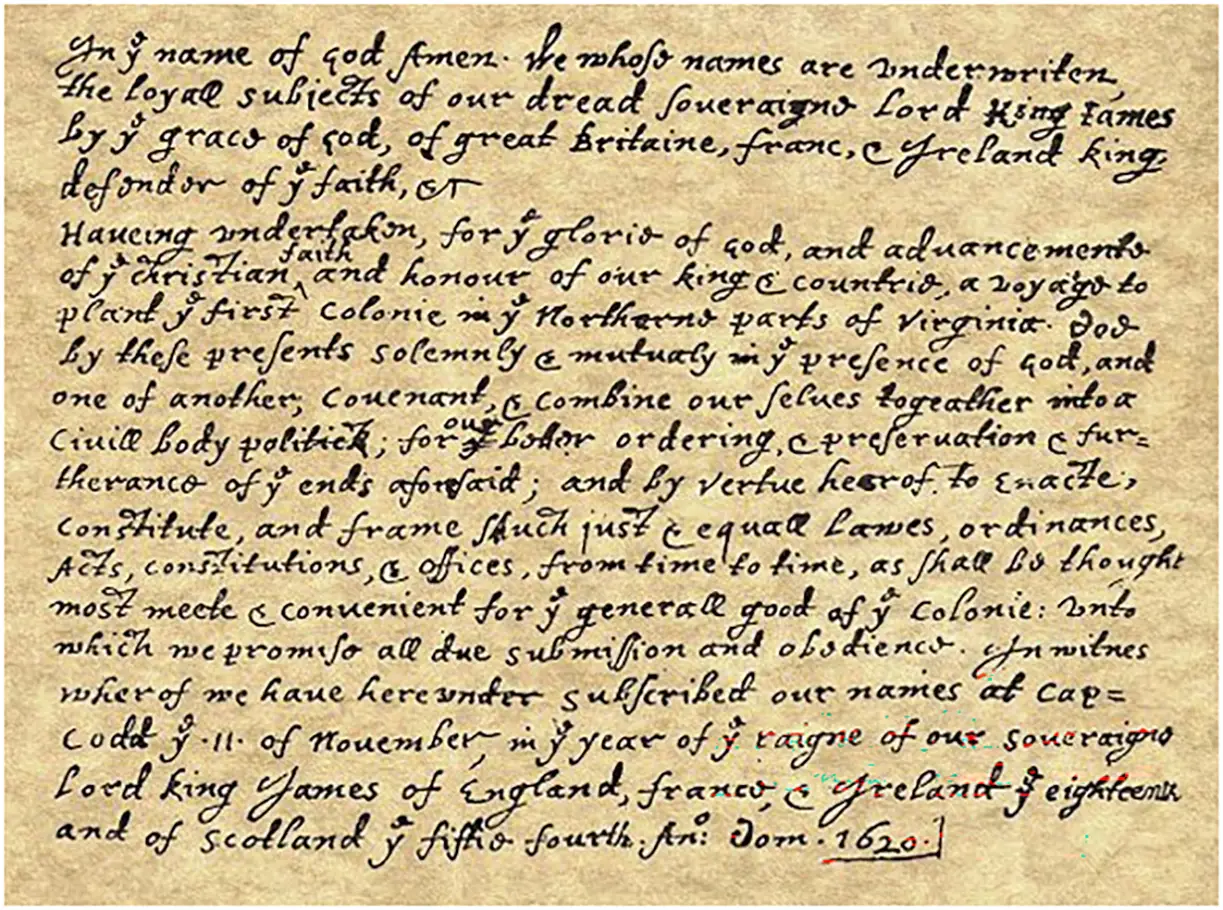
This immortal Mayflower Compact was signed in the tiny cabin of the Mayflower on November 11 by all adult males whatever their stations. The Compact was modeled on the Covenant by which the Pilgrims had lived in Leyden for more than a decade and was later hailed by John Quincy Adams, among others, as “the first example in modern times of a social compact or system of government instituted by voluntary agreement … by men of equal rights … ” Thus it was that The Mayflower Compact came into being and was signed by the adult male passengers in November, 1620.
While the language of Shakespeare’s day might seem quaint to us today, the spirit of democracy set forth in this famous document is timeless.