History of the Mayflower

In July 1620, two merchant vessels—the Mayflower and the Speedwell—were chartered to undertake one of the most famous transatlantic voyages in human history, aiming to transport English religious separatists, known today as the Pilgrims, to the New World. The voyage was conceived as a joint venture between the Leiden congregation, who had been living in exile in the Netherlands to escape religious persecution, and a group of London investors looking to establish a profitable plantation in North America. The Speedwell, a smaller 60-ton ship, was purchased by the congregation in Holland to bring the Dutch exiles to England and then accompany the larger, 180-ton Mayflower across the Atlantic, intending to remain in America as a fishing and trading vessel. However, what was planned as a coordinated two-ship expedition quickly evolved into a grueling saga of structural failure, logistical frustration, and ultimate perseverance.

The trouble began almost immediately after the two ships met in Southampton, England, to begin their journey. Shortly after setting sail on August 15, 1620, the Speedwell began leaking severely, forcing both ships to redirect and drop anchor in Dartmouth for repairs. After a week of maintenance, the vessels set out once more, but when they were roughly 300 miles off the southwest coast of England, the Speedwell again took on massive amounts of water. The crew and passengers were plagued by structural instability, forcing both ships to return to port, this time in Plymouth, England. Historians later suggested that the Speedwell’s leaks were not entirely accidental; its master, Captain Reynolds, had allegedly fitted the ship with oversized masts that strained the hull, possibly to intentionally sabotage the voyage and escape his year-long contract. Realizing the Speedwell would never survive the open ocean, the leaders made the difficult decision to abandon the smaller ship, drastically reshaping the course of their migration.

This critical setback forced a massive consolidation of resources and passengers that would redefine the legacy of the Mayflower. Mayflower,Steps,Disembarkation,Memorial,Next,To,Harbor,Plymouth,Devon,England.The travelers were forced to divide their company, leaving some behind in England while cramming 102 passengers and roughly 30 crew members onto the Mayflower alone. When the Mayflower finally departed Plymouth on September 16, 1620, it did so entirely by itself, facing the treacherous Atlantic winter storms much later in the season than originally planned. The history of these two ships represents a stark contrast between a vessel that failed under pressure and one that endured against all odds. While the Speedwell was sold and ultimately refitted into a successful merchant ship in England, the Mayflower pushed forward into history, braving a brutal 66-day solo crossing to establish Plymouth Colony and forever cementing its name as the singular vessel of the Pilgrim story.
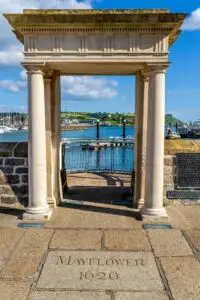
The picture here is of the Mayflower steps in Plymouth, England. These are the steps that the Mayflower passengers and crew used when they finally embarked on their voyage. 

Scroll to Top